Mechanical era (1450 - 1840)
The mechanical age is when we first start to see connections between our current technology and its ancestors. The mechanical age can be defined as the time between 1450 and 1840. There were lots of different machines created during this.A. The first information explotion
1. Johann Gutenberg (Mainz, Germany; c.
1387-1468) . Invented the movable metal-type printing process in 1450.

B. The first general purpose (computers)
-John Napier – introduces logarithms. He invents
logs in 1614. Logs allow multiplication and division to reduced to addition and
subtraction.
-Wilhelm Shickard – a professor at the
University of Tubingen, Germany, invents the first mechanical calculator, it
can work with six digits, and carries digits across columns. It works but never
beyond the prototype stage.
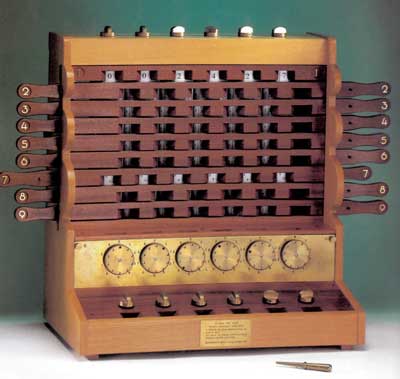
-William Oughtred, an English clergyman,
invented the slide rule. Early example of an analog computer.

-Blaise Pascal – a French Mathematician invented
a mechanical calculation machine called the Pascaline.. The pascaline was made
up of clock gears, and levers, and could solve basic mathematical problems like
addition and subtraction

-Gottfried
Wilhelm von Leibniz (1646-1716),
German mathematician and philosopher invented the stepped reckoner, a machine able to
resolve four basic arithmetic operations, which could multiply 5 digit and 12
digit numbers yielding up to 16 digit numbers.

-Charles
Babbage invented the first,
modern computer design: a steam-powered adding machine called “the difference
engine.”
-Joseph Marie Jacquard developed an automatic
loom that was controlled by punch cards.
-The first program was written by Ada Augusta Lovelace for Babbage’s Difference Engine. Thus Ada Lovelace is credited with being the first computer programmer. The programming language Ada is named in her honor.
you did a good work (:
ResponderBorrar